
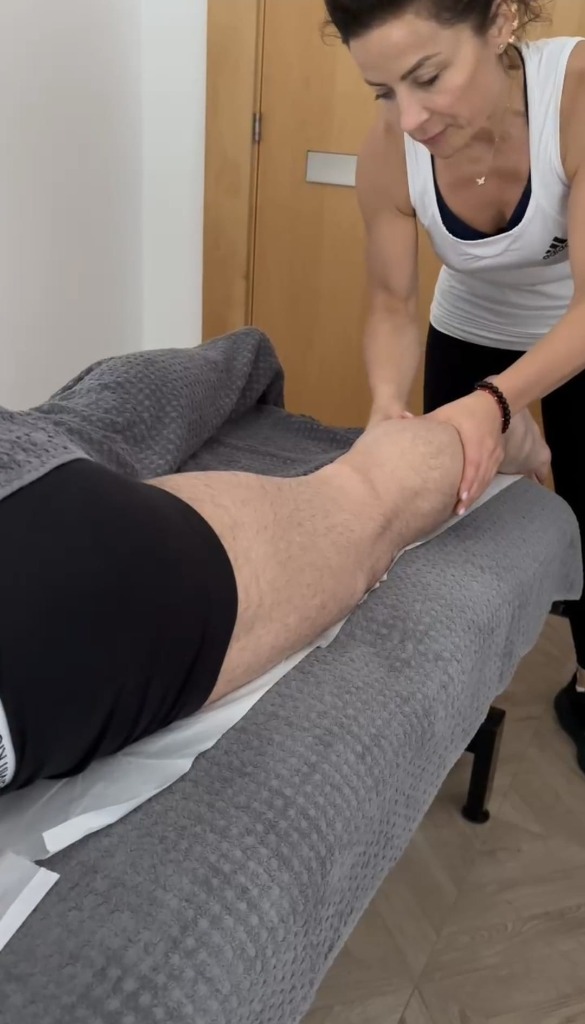
Understanding the Sciatic Nerve
The sciatic nerve is the longest and thickest nerve in the human body — roughly the diameter of your little finger. It originates from nerve roots L4 through S3 in the lumbar and sacral spine, passes through the greater sciatic foramen, runs deep beneath the piriformis muscle, and continues down the posterior thigh to the foot.
When this nerve is compressed or irritated, the result is sciatica: a radiating pain, tingling, numbness or weakness that can travel from the buttock all the way to the toes. It affects approximately 40% of people at some point in their lives (Konstantinou & Dunn, BMJ, 2008), making it one of the most searched pain conditions online.
Piriformis Syndrome: The Hidden Culprit
In approximately 6–8% of sciatica cases, the compression is not spinal but muscular. The piriformis — a small, deep external rotator of the hip — passes directly over (and in 17% of the population, the sciatic nerve actually passes through) this muscle. When the piriformis becomes hypertonic, inflamed or spasmed, it compresses the sciatic nerve mechanically.
Piriformis syndrome is notoriously under-diagnosed because imaging studies look normal — there is no disc herniation or spinal stenosis. The diagnosis is clinical: pain on sustained sitting, deep buttock ache, pain on internal rotation against resistance (the FAIR test), and tenderness on palpation of the piriformis.
Who Gets Piriformis Syndrome?
- Desk workers — prolonged sitting compresses the piriformis against the sciatic nerve for hours daily
- Runners and cyclists — repetitive hip flexion and overuse creates microtrauma in the piriformis
- People who carry wallets in their back pocket — creates an asymmetric pressure point directly over the piriformis
- Those with pelvic imbalance — sacroiliac joint dysfunction forces the piriformis to work overtime as a stabiliser
The Science of Massage for Sciatica
A randomised controlled trial published in Complementary Therapies in Clinical Practice (2014) demonstrated that deep tissue massage significantly reduced sciatic pain intensity and improved functional mobility compared to standard physiotherapy exercises alone.
The mechanisms are multi-layered:
1. Direct Piriformis Release
Using elbow or thumb pressure applied progressively to the piriformis origin and belly, the therapist can achieve a neurological release of the muscle spasm. This is not simply "pressing on a knot" — it works through the Golgi tendon organ reflex, where sustained pressure triggers an inhibitory signal from the spinal cord that forces the muscle to relax. The sciatic nerve decompression is often immediate.
2. Gluteal Complex Decompression
The piriformis rarely operates in isolation. The gluteus medius, minimus, and the deep lateral rotators (gemellus superior/inferior, obturator internus/externus, quadratus femoris) all contribute to the entrapment environment. Systematically releasing the entire gluteal complex reduces the collective pressure on the sciatic nerve pathway.
3. Lumbar Paravertebral Release
Even in true piriformis syndrome, the lumbar erector spinae and quadratus lumborum are typically involved in a compensatory guarding pattern. Releasing these muscles improves spinal segmental mobility and reduces referred input to the sciatic nerve roots.
4. Hamstring & IT Band Work
The sciatic nerve runs beneath the biceps femoris in the posterior thigh. Tight hamstrings increase neural tension along the entire pathway. Myofascial release of the hamstrings and iliotibial band creates neural flossing — gently mobilising the nerve within its sheath to restore normal gliding.
A Typical Treatment Session
At Mayfair Massage & Therapy, a sciatica-focused session follows a systematic protocol:
- Lumbar warm-up — broad strokes to increase circulation and reduce superficial guarding
- Quadratus lumborum and erector spinae release — addressing the compensatory pattern
- Progressive piriformis release — deep, sustained pressure with client feedback on pain reproduction
- Gluteal complex work — systematically releasing all six deep rotators
- Hamstring myofascial release — reducing neural tension along the sciatic pathway
- Gentle hip mobilisation — restoring range of motion in flexion and internal rotation
Most clients report significant improvement within 2–3 sessions, with complete resolution of piriformis syndrome typically achieved in 4–6 sessions spaced over 3–4 weeks.
"If your sciatica worsens with sitting and eases with walking, there is a strong probability that piriformis syndrome — not a disc problem — is the cause. Skilled manual release of this muscle can produce dramatic, rapid improvement."
— Concetta, Lead Therapist